

Dosage and Administration
What factors determine the selection of the appropriate dose of epinephrine?
Selection of the appropriate dose of epinephrine is determined according to patient body weight and is described in the table below. Each EPIPEN Auto-Injector contains a single dose of epinephrine. Since the doses of epinephrine delivered from EPIPEN are fixed, consider using other forms of injectable epinephrine if doses lower than 0.15 mg are deemed necessary. The prescriber should carefully assess each patient to determine the most appropriate dose of epinephrine.1,2
| Auto-Injector | Patient Weight | Epinephrine Concentration |
|---|---|---|
| EPIPEN Auto-Injector Epinephrine, USP Auto-Injector 0.3 mg |
>= 30 kg (>= 66 pounds) | 0.3 mg (0.3 mL) |
| EPIPEN JR Auto-Injector Epinephrine, USP Auto-Injector 0.15 mg |
15-30 kg (33-66 pounds) | 0.15 mg (0.3 mL) |
How to Use EPIPEN Auto-Injector and Its Authorized Generic
Why is it important to counsel patients on the correct administration technique for the EPIPEN Auto-Injector?
Familiarity with the Trainer is key, as epinephrine auto-injectors are often used under stressful conditions. Encourage your patients to practice with the Trainer provided in each carton, which contains no needle and no medication.1-5
Where can I find the complete directions for use for EPIPEN and its authorized generic?
Download the Patient Information for EPIPEN and EPIPEN JR Auto-Injectors, including complete directions for use, and/or download the Patient Information for the authorized generic to EPIPEN, including complete directions for use.
Administering Epinephrine
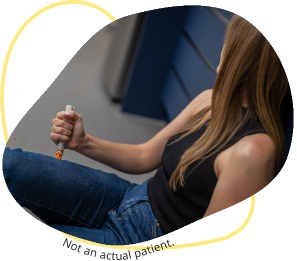
What are the 2 primary reasons patients should carry 2 EPIPEN Auto-Injectors?
- 20% of patients may need a second dose due to ongoing symptoms.3
Epinephrine—first-line treatment
“If a patient responds poorly to the initial dose or has ongoing or progressive symptoms despite initial dosing, repeated dosing may be required after 5 to 15 minutes. Reports of patients receiving epinephrine for food-induced or non–food-induced anaphylaxis note that as high as 10% to 20% of individuals who receive epinephrine will require more than 1 dose before recovery of symptoms.”3 - 20% of patients may experience a biphasic reaction.3
Time course of food-induced anaphylaxis
“A biphasic reaction includes a recurrence of symptoms that develops after apparent resolution of the initial reaction. Biphasic reactions have been reported to occur in 1% to 20% of anaphylaxis episodes and typically occur about 8 hours after the first reaction, although recurrences have been reported up to 72 hours later.”3
Storage and Disposal
How should EPIPEN Auto-Injectors be stored?
EPIPEN and EPIPEN JR Auto-Injectors and Epinephrine Injection, USP, should be stored in the carrier tube provided at a temperature of 20 °C to 25 °C (68 °F to 77 °F); however, temperature excursions between 15 °C to 30 ºC (59 °F to 86 ºF) are permitted.1,2 EPIPEN, EPIPEN JR, and Epinephrine Injection, USP Auto-Injectors should not be stored in refrigerators or in a vehicle’s glove box.1,2 EPIPEN Auto-Injectors and their authorized generic auto-injectors should not be exposed to extreme heat or cold and should be protected from light.1,2
Use the protective case to prevent exposure to light and prevent damage to the auto-injectors. The protective case is not waterproof.
How can a patient ensure that their EPIPEN Auto-Injector is chemically stable?
Epinephrine solution deteriorates rapidly on exposure to air or light, turning pink from oxidation to adrenochrome and brown from the formation of melanin. Patients should be instructed to visually inspect the epinephrine solution periodically for particulate matter and discoloration. Patients should also be advised to replace their EPIPEN Auto-Injector if the epinephrine solution contains particulate matter or develops a pinkish or brown color, because these changes indicate that the effectiveness of the drug product may have decreased or been affected. It is important to follow recommended storage conditions.1,2
How can a patient dispose of their EPIPENs?
Dispose of expired, unwanted, or unused EPIPEN Auto-Injectors in an FDA-cleared sharps disposal container right away after use. Do not throw away the EPIPEN Auto-Injector in household trash. If the patient does not have an FDA-cleared sharps disposal container, they may use a household container that is:
- Made of heavy-duty plastic,
- Can be closed with a tight-fitting, puncture-resistant lid, without sharps being able to come out,
- Upright and stable during use,
- Leak-resistant, and
- Properly labeled to warn of hazardous waste inside the container.
For more information about safe sharps disposal, and for specific information about sharps disposal in the state that you live in, visit the FDA’s website.